Learning Pathway
How students progress through the Five Groupings.
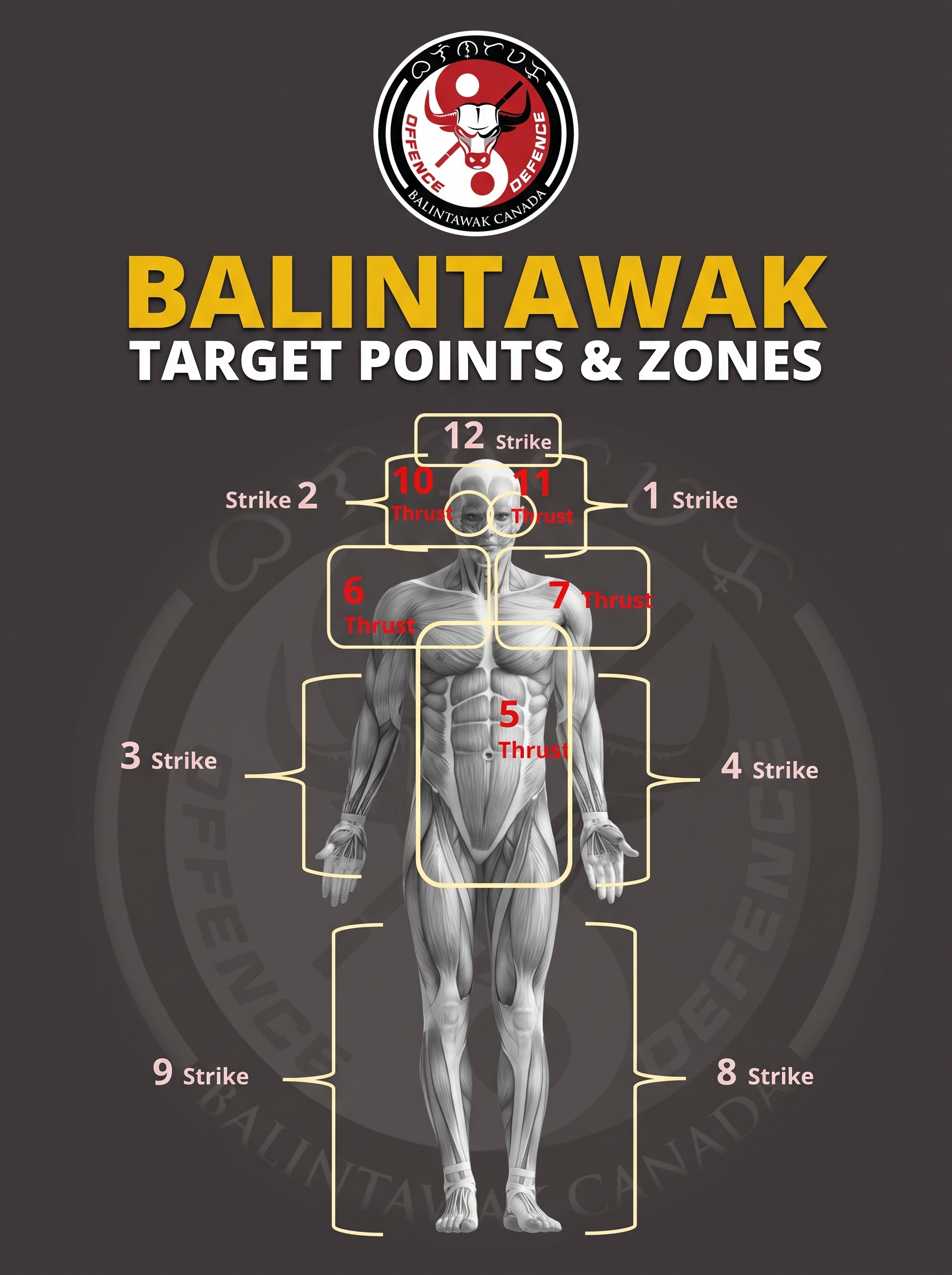
Every grouping is fed and read against the same numbered reference: the 12 strikes and 5 thrusts mapped to the target points and zones shown above. Learning to call, recognize, and defend these numbers cleanly is the foundation that every later grouping builds on.
Structure First, Randomness Later
A grouping curriculum gives the beginner a vocabulary. Palakaw / guided feeding then turns that vocabulary into conversation: learn the basic strike, defense, body position and purpose of the lesson; recognize the cue early enough to choose the correct response without guessing; vary angle, timing, pressure, distance and live-hand problem while preserving the principle; then flow — remove the numbered order and respond to unpredictable feeding.
The goal is not “knowing Group 1 to Group 5.” The goal is to make the lessons disappear into reflex, timing, accuracy, precision, balance, control and judgment.
Balintawak is taught through five structured groupings of attacks, designed by our predecessors to ensure a gradual, systematic, and responsible progression. This method preserves correct setup, intelligent movement, functional technique, and clear execution — no shortcuts, no guesswork, just proper formation.
Group 1 — Foundations
Building the foundations of combat readiness: habits, hitting principles, distance and range detection (largo mano, medio, corto), holding and lifting, and the basics of close-quarter stick hitting.
Group 2 — The Other End of the Stick: The Butt
Parrying as redirection and counter preparation, defensive head movement, butting defense, and an introduction to different hitting patterns: redondo, otso-otso, tutsada, saltada, abanico, witik, dagit, labtik, latos.
Group 3 — Thrusting
Tutsada, duslak, luba, tastas, banda-banda, sungkit — thrusting defense, disarms using thrusting, and protecting the centerline.
Group 4 — Hitting
Handling, cabra, bangil, and abanico defense and offense, with emphasis on the left hand, pakgang, checking, and undayag.
Group 5 — Integration
Defense against clipping, pulling, handling, and punching; relaxation and sensitivity; balance, sweeping, and takedowns — bringing the earlier groupings together.
Students who complete the Five Groupings continue into Advanced Training, integrating Balintawak with knife fighting, mano-mano, and close-quarter combat principles.
Ready to Begin?
Reserve a free introductory class and experience Balintawak Eskrima firsthand.