History & Cebuano Heritage
Born in Cebu. Preserved in Canada. Shared with the world.

Balintawak Eskrima was founded by Venancio Bacon in Cebu as a Cebuano Filipino Martial Art — a single-stick, close-quarter system built for real combat. The art was later organized into five structured groupings by Teofilo Velez and Jose Villasin, ensuring a clear and systematic method of learning.
Balintawak Canada exists to preserve, teach, and share the living art of Balintawak Eskrima — a Cebu-born Filipino Martial Art shaped by history, survival, rhythm, intelligence, humility, and the fighting spirit of a people who endured invasion, colonization, oppression, poverty, and hardship without losing their dignity, creativity, faith, and joy.
We are open to being nourished by the wider richness of Filipino Martial Arts, because Balintawak belongs to the larger Filipino fighting heritage. At the same time, we remain faithful stewards of our own lineage, method, discipline, and responsibility.
“Atoa ni — higugmaon nato kini!” This is ours — let us cherish it.
Page 1 of 3 · The Founder
Venancio “Anciong” Bacon — The Source of Balintawak
Born in Carcar, Cebu in 1912 and raised in San Nicolas, Bacon learned eskrima as a young man under Lorenzo “Ensong” Saavedra. His approach became known for close-quarter efficiency, economy of movement, precision, speed, and decisive counter-fighting.
In the 1920s he trained in San Nicolas alongside Teodoro “Doring” Saavedra; by the 1930s he was part of Cebu's active eskrima community and among the early members associated with Doce Pares. In 1952, Bacon and companions established the Balintawak Self-Defense Club, training behind Eduardo Baculi's watch shop on Balintawak Street near Colon, Cebu City — the art's namesake. The 1950s–60s “Golden Age” of Cebu eskrima tested skills in demanding, sometimes dangerous encounters and cemented Balintawak's reputation for practical close-range fighting.
Balintawak was not simply preserved as a collection of techniques; it survived as a living method of learning to see, feel, respond, and adapt at close range — built on corto range, the single stick, counter-for-counter adaptation, and economy of motion.
GGM Teofilo “Pilo” Velez — Organizer, Teacher & Promoter
Teofilo Velez became one of the crucial bridges between Bacon's demanding personal instruction and a structured method that could be passed to larger numbers of students. Accounts from the Balintawak community describe him as a teacher, organizer, promoter, and faithful defender of the art.
Historical sources do not always credit the “grouping” method in exactly the same way — some emphasize Atty. Jose Villasin, others Teofilo Velez, several a Villasin–Velez collaboration. Balintawak Canada presents the safer shared point: Bacon's material was organized into progressive teaching groupings so students could absorb the art more systematically, then return to freer, responsive application — an evolution that let Balintawak travel beyond one backyard and one generation while retaining its close-quarter identity.
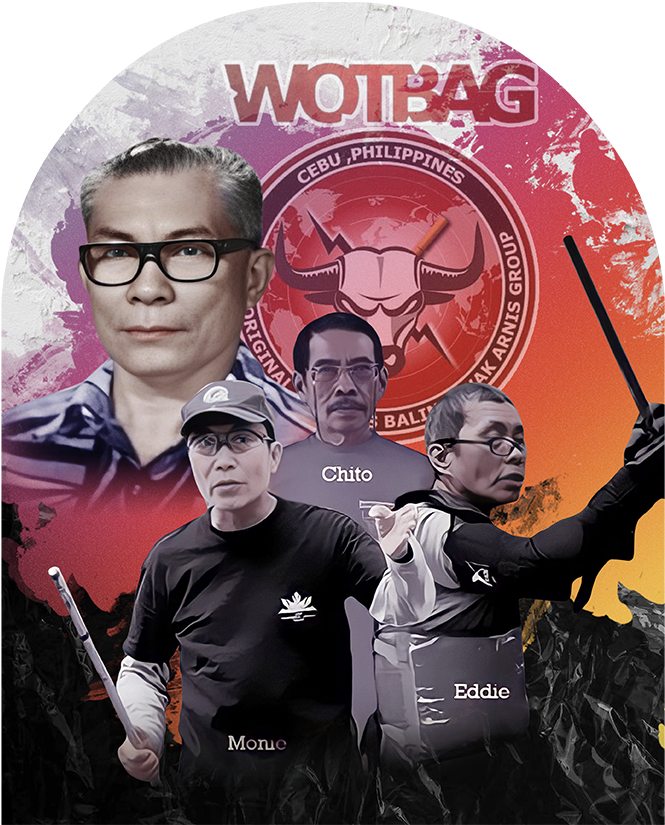
Sam Buot's historical account describes nightly workouts of the Villasin–Velez branch at Teofilo Velez's home, with GGM Bacon making check-ups. Velez's senior training circle included his sons and other important Balintawak teachers. By 1982, Teovel's Balintawak Group is reported as formally organized: Venancio “Anciong” Bacon → Jose Villasin + Teofilo Velez → Chito · Monie · Eddie Velez, the Teovel's/WOTBAG living bridge.
The Three Velez Brothers — Pillars of WOTBAG
WOTBAG — the World Original Teovel's Balintawak Arnis Group — identifies Pacito “Chito” Velez, Ramon Franco “Monie” Velez, and Eduardo “Eddie” Velez as Teofilo Velez's sons, successors, and early instructors, tracing their teaching directly through their father to Anciong Bacon.
GM Chito Velez carried the responsibility of leadership after Teofilo Velez and became a central figure in continuing Teovel's Balintawak. GM Monie Velez is remembered as a deeply knowledgeable teacher who encouraged exploration, timing, reflex, and mature understanding of the art. GM Eddie Velez is known within the Velez teaching circle for hard, realistic training and a strong emphasis on practical application. WOTBAG's own history describes the brothers' teaching as emphasizing flexibility, timing, speed, hitting points, defense, offense, and knife-fighting skills — all anchored in what they received from GGM Teofilo Velez.
Many other teachers helped carry Balintawak across Cebu and around the world, including Jose Villasin, Teddy Buot, Timor Maranga, Arnulfo Mongcal, Arturo Sanchez, Sergio Arcel, Sam Buot, Bobby Taboada, Bobby Tabimina, Nick Elizar, Nene Gaabucayan, and Oliver Mag-uyon — a respectful, non-exhaustive recognition, not a ranking.
Heritage note
Balintawak has many respected branches. Dates, teaching-method attributions, and individual lineage details can vary between oral histories and organizations. This page intentionally focuses on the shared historical spine and Balintawak Canada's WOTBAG heritage, while honoring other branches.
Ready to Begin?
Reserve a free introductory class and experience Balintawak Eskrima firsthand.